Astronauts arrive at International Space Station on the quickest US express flight yet
Four astronauts pulled up at the International Space Station on Thursday after launching on an eight-hour express that set a U.S. speed record.
Latest science news, discoveries and scientific developments.
Four astronauts pulled up at the International Space Station on Thursday after launching on an eight-hour express that set a U.S. speed record.
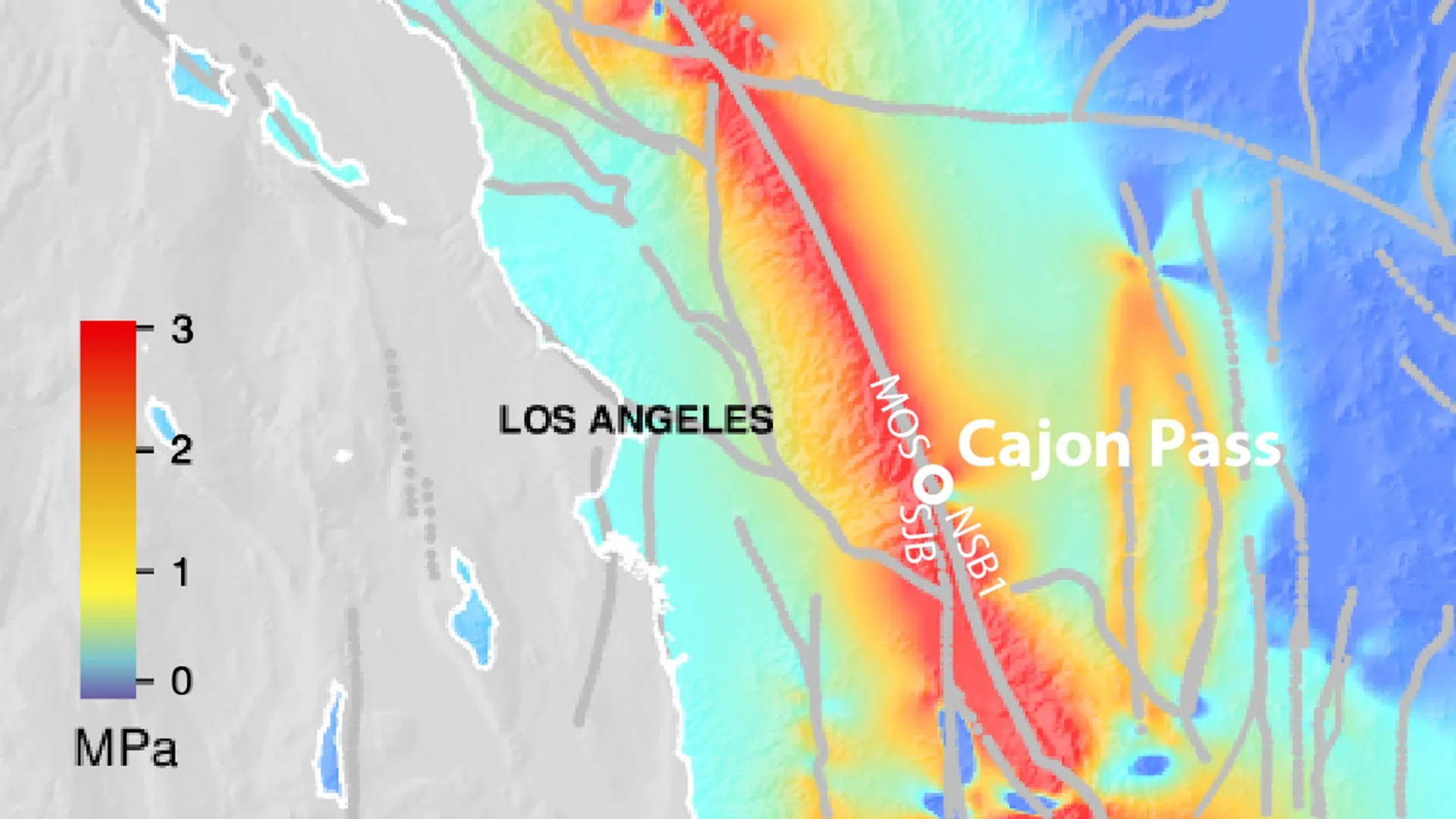
Researchers say stress on Southern California’s San Andreas and San Jacinto faults has reached some of the highest levels seen in a 1,000-year simulation. Because both faults are highly stressed at the same time, the Cajon Pass junction may be increasingly primed for a rupture that could cross both systems, although the study does not predict when an earthquake will happen.
High sea temperatures driven by the climate crisis damage corals, bleaching them ghostly white and killing them. While restoration of dead reefs is possible, it's difficult and expensive, and restored corals are vulnerable to future heat waves. Finding ways to stop or slow the damage to existing reefs is crucial.
An instrument built to study cosmic rays has turned out to be a powerful tool for investigating thunderstorms. Earlier observations with the GRAPES-3 muon telescope revealed that thunderclouds can develop electrical potential differences far greater than those ever measured directly. But they also uncovered a puzzle: the instrument detected many more thunderstorm events in the eastern part of its field of view than in the western part. A new study by the same team, published in the Journal of Cosmology and Astroparticle Physics, has now explained why.
Weak sunlight can still damage skin DNA if you spend enough time outdoors, according to a landmark Australian study. Even UV doses too low to cause visible redness triggered cellular damage that could accumulate over time and contribute to skin cancer risk.
Scientists at the University of Chicago have uncovered a surprising quantum state in the layered magnetic material Fe5GeTe2, where huge numbers of electrons move together unusually slowly while remaining quantum coherent. The behavior contradicts existing theoretical predictions about how the material’s magnetism should work and suggests scientists may need to rethink its underlying physics.
The global annual amount of carbon dioxide (CO₂) released through the microbial decomposition of soil organic carbon is estimated to be approximately five times greater than anthropogenic CO₂ emissions, highlighting the importance of understanding how climate change affects soil CO₂ release dynamics.
Scientists found that five seemingly unrelated conditions, including long Covid, ME/CFS, and PTSD, may disrupt many of the same biological networks involved in immunity, metabolism, and cellular energy. The findings could help explain their shared symptoms and may open the door to new blood tests and treatments.
Scientists may have found a clue to one of the biggest mysteries surrounding the origin of life: how fragile RNA molecules could gather and survive before cells existed. New research shows that RNA is unusually good at assembling into tiny liquid-like droplets that concentrate molecules and can harden into protective, gel-like structures. Remarkably, much of this behavior may come down to a single oxygen-containing chemical group that RNA has but DNA lacks.
Magnetic properties in molecular materials depend not only on the molecular components themselves but also on their solid-state organization. In charged π-electronic systems, electrostatic and dispersion forces can organize molecules into distinct ion-pairing structures.
Choruses of African elephant rumbles appear to become more similar in certain situations, including reuniting or coordinating what to do next. Now, new research published in Scientific Reports provides evidence that elephant rumble choruses function as group signals.
Camelina is a relatively new oilseed gaining interest for its potential use in food, livestock feed and renewable fuel markets. A newly published research paper provides insights into the camelina genome that could give breeders new tools to develop varieties with improved performance, stronger adaptability and traits that matter at the farm level.
Next-generation computing technologies could be one step closer to emulating how neurons respond and communicate with each other, thanks to research examining how electrons and ions move through materials.
A new research paper published in Zootaxa describes five new species of freshwater mussels in the southern U.S., providing the scientific foundation for protecting the most imperiled group of animals in North America.
It was the first day of school, and the kids at the Logan Intergenerational Family Education Center were not going to wait a second longer. Normally, the hordes of elementary schoolers would take turns chattering down the hallway to meet and visit their best friends—the senior-citizen residents of the Logan Manor nursing home—during breakfast.
Researchers have developed a practical strategy for recovering biosynthetic information from fragmented metagenomic data. Through this work, the researchers identified and prioritized promising natural-product candidates with potential antibacterial or anticancer activity.
A small protein known as p11 may play a much broader role in cellular signaling than previously thought. Researchers at Karolinska institutet have now shown that p11 interacts with numerous receptors targeted by commonly used medicines, opening new possibilities for treating conditions such as pain, inflammation and depression. The research is published in the journal Science Advances.
Human activity and climate change are putting growing pressure on water resources, disrupting the predictability of the water cycle and changing the availability and quality of freshwater. IIASA researchers and partners have developed a new framework for guiding water management and planning at the river basin level, derived from the existing Global Water Planetary Boundary.
In the early history of our solar system, scientists theorize that a Mars-sized object called Theia smashed into the infant Earth, vaporizing massive amounts of rock and blasting it into space. Some of that material coalesced into the moon, where NASA's Artemis program is returning humans, preparing for Mars and shaping the future of space exploration.
Working in close collaboration, researchers from Paderborn University, the University of Basel and Ruhr University Bochum have made a breakthrough in quantum communication. In their recently published paper in the journal Physical Review Letters, they demonstrate how special semiconductor nanostructures can be used to generate individual photons and pairs of photons that are almost perfectly identical. These "indistinguishable" particles form the basis for quantum entanglement and quantum interference.