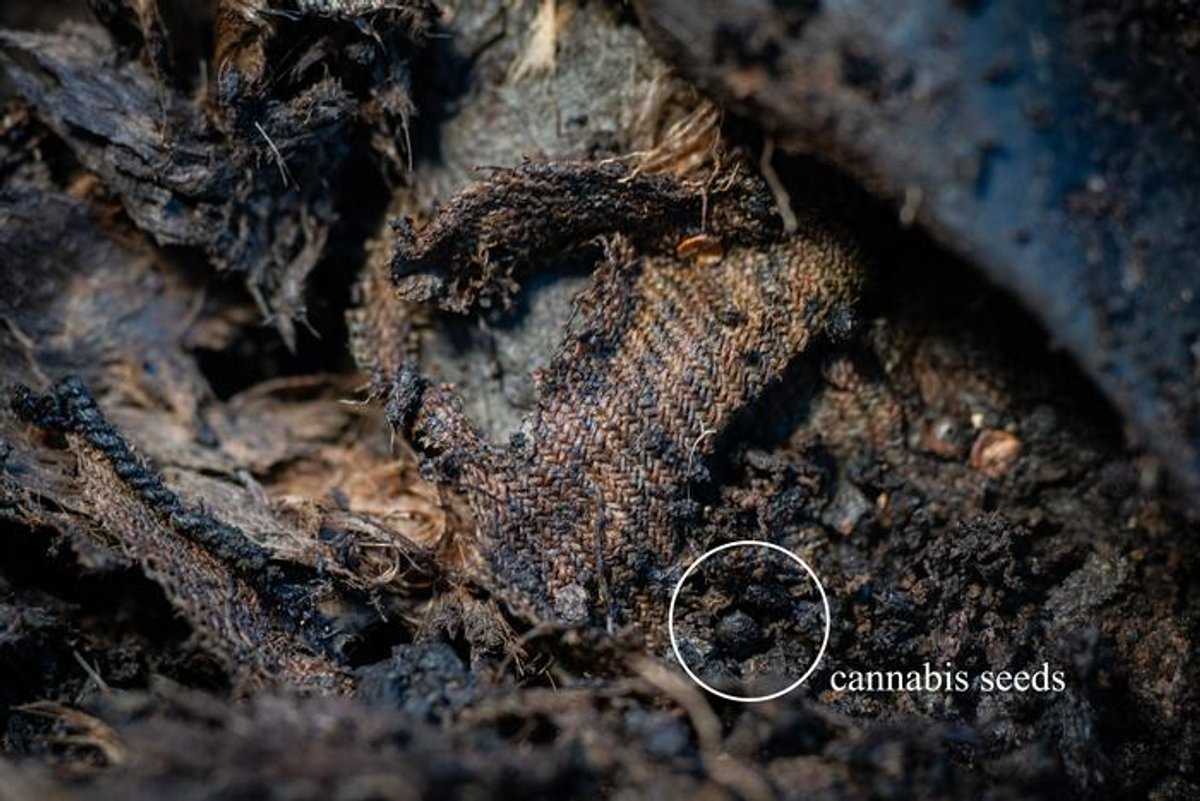
Ancient humans used cannabis in burial rituals 2,800 years ago
New findings from a Siberian tomb offer the earliest direct evidence for human marijuana use
Stay informed about scientific discoveries, research developments and new findings from around the world.
New findings from a Siberian tomb offer the earliest direct evidence for human marijuana use
Learn more about the scientific community coming into office in January
The oceanβs blue and green hues near the infamous zone of debris have gotten brighter over the past 20 years, satellite data show
As sea levels creep higher in the Pacific, salt leaches into the soil and reduces the land available to grow food. Ocean warming is damaging coral reefs, reducing fish stocks, and salinity has tainted freshwater supplies.
Newton's theory of gravity has described the tides accurately for centuries. But could a tiny trace of Einstein's general relativity also be hidden in them? In a new study, a mathematician at Freie UniversitΓ€t Berlin has outlined how a targeted approach could be used to search for effects of this nature.
NASA's Neil Gehrels Swift Observatory took its last look at the sky on Oct. 20, 2026, while orbiting about 171 miles (275 kilometers) above Earth. NASA ended the telescope's mission three days later, because Swift had sunk so low that drag from the thin air there meant its telescopes couldn't hold steady.
The federal government is pushing for a "digital detox" in schools.
Around 4.5 billion years ago, a planet-sized object collided with the newly formed Earth, throwing out the debris that would later form the moon. The collision left Earth spinning extremely fast, with days lasting just two to five hours. Yet existing models of how Earth's first crust formed and evolved have largely overlooked how the planet's later slowdown might have affected it.
A Dutch family doctor named Tibor Poelmann posted a petition on an online forum for general practitioners (GPs) in 2021. He wanted their pension fund to stop investing in oil and gas. It quickly gathered 1,200 signatures.
Large pedestrian crowds generate distinctive seismic signals depending on their collective behavior, according to a new study that includes data from Tokyo schools and outdoor gatherings in the United States and Israel. These seismic signals are strongest in the 1β2 hertz frequency band, which is consistent with human walking frequencies.
Most young children like sharks, with almost seven in 10 describing them in a positive light, but a new study has found that associations between sharks and fear become more common as children get older.
It is one of the great questions of mathematics: What does "infinity" actually mean? Which infinities are larger than others? Can infinities be arranged in a sequence, like the rungs of an endless ladder, so that for any two of them we can always say which one lies above the other?
A new research paper describes a statistical framework that resolves significant calculation biases caused by artificial intelligence in econometric models. The method, two-step extraction, removes estimation bias when researchers measure the business or economic effects of variables extracted using machine learning algorithms from unstructured data such as photos and consumer text.
Johns Hopkins researchers searching the expanse of the universe for the existence of the first black holes are zeroing in on little red dots that may hold the key to the theoretical phenomenon.
Scientists have developed a remarkable new membrane that separates crude oil at room temperature, using the oil itself to create microscopic filtration channels. The breakthrough could cut refining energy consumption by nearly 32%, carbon emissions by almost 38%, and operating costs by 36%, potentially transforming one of the world's most energy-intensive industries.
There are no woodpeckers on the Hawaiian Islands, but a little yellow bird called the 'akiapΕlΔΚ»au (Ah-key-ah-pole-ah-ow) has evolved an unusual beak to drill into branches to find food.
Nudgesβthe subtle interventions that encourage people to make beneficial decisions without forcing them into these choicesβare a popular marketing tool widely used for a variety of social causes and business purposes. But their effectiveness depends on finding the right combination of context and content, says Siddharth Bhattacharya, an assistant professor of information systems and operations management at the Costello College of Business.
A new experiment reveals that Earth's microbes can grow in harsh conditions similar to what may exist just below the surface of Mars, suggesting new directions in the search for potential cellular life on the red planet.
When plants encounter pathogens, they can defend themselves by rapidly killing infected cells to restrict pathogen spread. This immune response, known as the hypersensitive response (HR), was first described in 1915. However, the molecular mechanism underlying HR cell death remained poorly understood for more than a century.
Scientists have discovered how to reprogram the internal structure of glass using a special molecule that rearranges chemical bonds while lowering the melting temperature. The breakthrough could unlock entirely new glass materials with precisely controlled magnetic and optical properties, opening possibilities for advanced electronics, sensors, and other technologies.
The find includes 280 engravings, including 55 depictions of animals
Adding phenanthrene as a co-guest let the second-generation crystalline sponge (2G-CS) method determine X-ray structures for 24 of 30 small, low-polarity Cββ molecules, mostly sesquiterpenoids. Under standard conditions, none of the 30 gave guest-containing crystals. Eleven of the 24 structures had not been reported before, including that of the liquid hydrocarbon longifolene. A chiral version of the cage gave the absolute configurations of five compounds.
A groundbreaking discovery is rewriting the story of human evolution, revealing that an ancient human species once thought to be an evolutionary dead end may have left genetic traces in people alive today. By extracting proteins from 400,000-year-old Homo erectus teeth discovered in China, scientists uncovered evidence suggesting that these early humans interbred with Denisovans, another mysterious ancient human group. That genetic connection may have eventually reached modern populations in the Philippines, Papua New Guinea, and other parts of Southeast Asia.
In order to know where you're going, you must know where you've been, says an old adage. And a new UNLV housing supply rankings report is putting that proverb into practice by providing policymakers and the public with the nation's first comprehensive look at how state-level new home permitting activity stacks upβand offering clues on local, state or regional measures that could help drive down skyrocketing prices.